| Sintered bearings | ||||||||
|
The shaft of a jigsaw is guided in porous bearings. A turning mechanism is obtained by an at a gear eccentric fixed ball bearing that moves horizontally in a sleeve. |
||||||||
|
►Porous bearings are manufactured by sintering, e.g. powder is pressed to parts at high temperature and high pressure. Despite of the powder is melted together capillary channels between the particles remain resulting in a porous material. By impregnation of these channels with liquid or solid lubricants, the bearing material may contain enough lubricant for life. As a fact of the capillary channels porous materials are brittle and sensitive to cracks. Examples of sintered porous bearing materials are carbon brushes of electric drives, porous bronze bearing bushes, engineering ceramics, products made by rapid prototyping and sintered polymers.
Porous bronze bearings are frequently applied in consumer products.
Those bearing materials consist of 90%
bronze, 10% tin and often some addition of graphite and lead to improve
dry running properties. Porous
iron bearings can take up higher bearing loads but have a lower
permissible sliding speed. circulation of oil in the bearing>>> 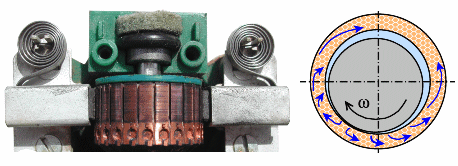
|
||||||||
|
Morgan, V.T. and Cameron, A, 1957, "Mechanics of lubrication in porous metal bearings". Proceedings of the conference on lubrication and wear. London, p.151-157. Braun, A.L., "Investigations on porous bearings", Philips Nat. Lab. Technical note no. 155/77 |
||||||||
| www.tribology-abc.com |
